Why Roof Moss Grows So Fast in Southern Oregon
Key Takeaways
Southern Oregon’s issue isn’t total rainfall — it’s moisture duration.
North-facing slopes and tree canopy create long drying cycles.
Organic debris accelerates moss colonization.
Freeze/thaw cycles at elevation increase shingle vulnerability.
Moss growth here is predictable — and manageable with the right timing.
If you’ve lived in Southern Oregon for a few years, you’ve probably noticed a pattern: roofs here grow moss faster than you’d expect.
That can feel strange in a region with long, dry summers — but moss doesn’t care about annual rainfall totals as much as homeowners think.
What matters most is drying time. When shingles stay damp for long stretches (especially under shade), moss becomes predictable — and in Southern Oregon, those “slow-dry” conditions show up every year.
Field check: after a light rain, if one slope dries by afternoon and another stays dark into the next day, that darker section is where moss will set up camp first.
Roof maintenance isn’t complicated — but Southern Oregon makes it easy to get wrong if you follow generic advice. If you want a baseline you can actually use, this Southern Oregon roof maintenance framework lays out timing, inspection checkpoints, and the “clean vs. replace” decision points.
Use it as your baseline, then adjust based on shade, debris, and how fast your roof actually dries.
It’s Not Rainfall — It’s Surface Moisture Duration
According to regional climate data from the National Weather Service, most precipitation in the Rogue Valley falls between late fall and early spring.
But the real issue for roofs isn’t how much water falls.
It’s how long shingles remain damp afterward.
Moss growth correlates with time wet, not inches of rain. A roof that stays damp for two days after light rain can grow moss faster than a roof that dries in a few hours after heavier rain.
From roughly October through April:
- Temperatures are cooler.
- Sun angles are lower.
- North-facing slopes receive limited direct sunlight.
- Overnight humidity increases condensation cycles.
That means a roof may get wet… and not fully dry for days.
Under tree canopy, it can remain damp even longer.
Moss doesn’t need heavy rainfall.
It needs consistent moisture and time.
Southern Oregon provides both.
Tree Canopy Is a Major Amplifier
Established neighborhoods in:
- Medford
- Ashland
- Jacksonville
- Grants Pass
often have mature oaks, pines, and mixed evergreen coverage.
That canopy creates three moss-friendly conditions:
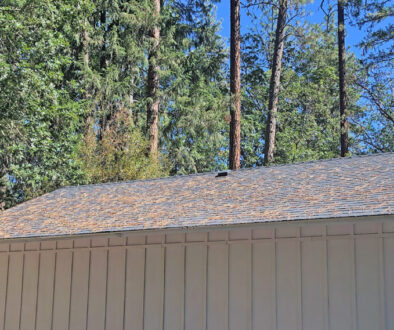
- Shade reduces UV drying.
- Debris collects in valleys.
- Airflow is limited.
Even in summer, shaded roof sections dry more slowly than exposed ones.
In winter, shaded north-facing slopes can stay damp for extended stretches — especially in neighborhoods near greenbelts or foothill zones.
Two homes on the same street can have dramatically different moss growth patterns based purely on shade and orientation.
North-Facing Slopes Are Predictably High-Risk
In Southern Oregon’s latitude, winter sun stays low in the southern sky.
That means:
- South-facing slopes receive consistent drying.
- North-facing slopes often receive little direct sun from November through February.
This creates a predictable pattern:
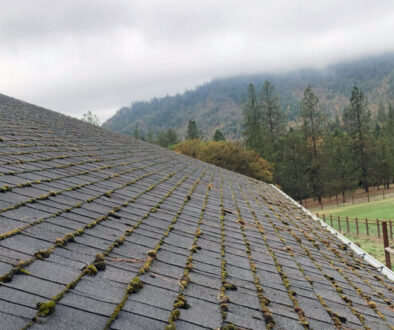
- Moss almost always starts on the north side.
- It expands into valleys.
- It moves upward if untreated.
This isn’t random.
It’s geometry.
If your primary roof slope faces north and sits under tree canopy, you should expect moss to grow faster than on a sun-exposed southern slope.
Debris Creates a Moss Incubator
Moss rarely appears on a perfectly clean, debris-free surface.
It thrives where organic matter collects.
Common Southern Oregon debris sources include:
- Pine needles
- Oak leaves
- Small twigs
- Valley accumulation
- Debris behind chimneys
- Buildup beneath solar panel arrays
When debris settles, it:
- Traps moisture
- Blocks airflow
- Prevents even drying
- Creates organic nutrients
Over time, this builds a microclimate that stays damp even when the surrounding shingles dry.
In wooded parts of Grants Pass and Jacksonville, debris management is often more important than chemical treatment.
Remove debris, and moss growth slows.
Ignore debris, and moss accelerates.
In many Southern Oregon homes, debris buildup is the trigger that turns “a little green” into full moss mats. That’s why a maintenance schedule matters — and why cleaning frequency should be based on exposure, not guesswork.
Cool Winters + Long Damp Cycles
Southern Oregon winters are not extreme — but they are persistently damp.
We often experience:
- Repeated light rain events
- Fog pockets in valley floors
- Overnight condensation
- Freeze/thaw at elevation (Ashland foothills)
When shingles remain cool and damp for extended stretches:
- Asphalt binders soften gradually.
- Granules loosen more easily.
- Moss rhizoids anchor more effectively.
Moss uses root-like structures (rhizoids) to anchor itself, and the longer a surface stays damp, the more established that growth becomes.
The longer the surface stays damp, the deeper those anchors set.
That’s why early-stage moss is easier to remove — and thick, rooted moss becomes more mechanical.
Freeze/Thaw at Elevation
In higher-elevation neighborhoods near Ashland and foothill zones, freeze/thaw cycles add another stress factor.
When moisture freezes within shingle layers:
- Expansion occurs.
- Micro-cracks form.
- Edges lift slightly.
Those small openings create better moss anchoring points the following damp season.
The result?
Elevated properties often experience faster visible moss colonization — even if rainfall totals are similar.
Attic Ventilation Can Make It Worse
Moss is usually thought of as a surface problem.
But roof systems work as a whole.
If attic ventilation is poor:
- Warm interior air rises.
- Condensation forms on the underside of the decking.
- Moisture persists longer within the roof assembly.
That means the roof can be experiencing moisture stress from both directions:
- Moss traps moisture above.
- Condensation holds moisture below.
This doesn’t cause moss directly, but it creates conditions that accelerate deterioration once moss is present.
In older Southern Oregon homes (1970s–1990s construction, especially), insulation and ventilation may not meet modern standards.
When evaluating moss issues, attic conditions should not be ignored.
Why Moss Feels “Sudden”
Homeowners often say:
“It wasn’t there last year — and now it’s everywhere.”
That perception happens because moss grows in stages:
- Microscopic colonization (invisible).
- Fine green film.
- Small patch clusters.
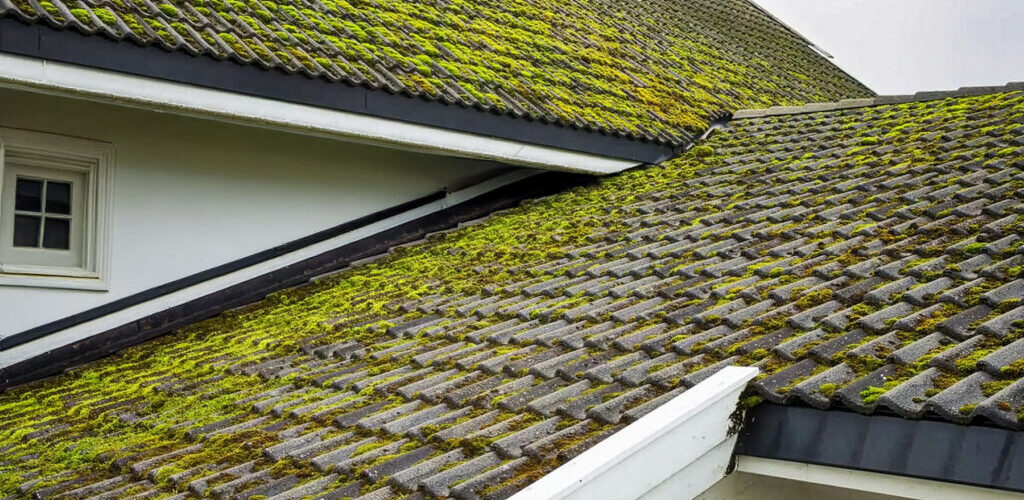
- Thick mat formation.
By the time it’s visibly thick, it has likely been developing quietly for months.
Southern Oregon’s climate allows that early stage to happen faster than most homeowners realize.
Is This Just Cosmetic?
In some climates, moss is largely aesthetic.
In Southern Oregon, it becomes structural over time.
When moss thickens:
- It lifts shingle edges.
- It holds moisture against granules.
- It slows drying cycles.
- It increases granule loss risk.
The Asphalt Roofing Manufacturers Association has long noted that prolonged moisture exposure accelerates asphalt degradation.
Here, the combination of:
- Shade
- Debris
- Long damp seasons
- Slow drying
makes moss more than a visual issue.
It becomes a lifespan factor.
If you’re wondering what removal method is safest for asphalt shingles (and what to avoid), the approach matters as much as the timing. Some cleaning methods remove moss fast — and remove years of roof life with it.
Can You Stop Moss Completely?
In heavy canopy neighborhoods, you can’t permanently eliminate moss. You can manage it, slow regrowth, and reduce how often it returns — but a “forever moss-free roof” isn’t realistic under dense shade.
What tends to work best in Southern Oregon is a simple system:
- Regular valley debris removal
- Early-stage treatment before thick mat formation
- Monitoring north-facing slopes
- Trimming overhang where possible
- Maintaining proper ventilation
The goal isn’t perfection. It’s controlled, predictable maintenance.
The Real Reason Moss Grows So Fast Here
Southern Oregon creates the perfect slow-drying environment: repeated damp cycles, shade from mature canopy, debris that holds moisture, and low winter sun angles that limit drying on north-facing slopes.
That combination makes moss growth feel inevitable — but it also makes it predictable. And predictable means manageable with the right schedule.
FAQs
-
Shade, slope orientation, and debris accumulation are usually the difference. Two homes a few houses apart can have very different drying cycles.
-
Less frequently, but debris buildup can still create moss-prone areas — especially under shade.
-
Not necessarily. If shingles remain flexible and structurally intact, cleaning may be sufficient. Condition — not appearance alone — determines replacement.
-
Higher elevations and freeze/thaw cycles can accelerate growth, but dense canopy areas anywhere in Southern Oregon are high-risk.
-
At least annually, and more often if your primary slope faces north or sits under heavy tree canopy.