Water Damage From Gutters & Roof Runoff in Southern Oregon (What to Watch)
Key Takeaways
- Most “water damage” starts as a drainage problem: roof runoff → gutters → downspouts → ground.
- If the same corner overflows repeatedly, it’s usually an outlet/pitch/hanger issue—not “just leaves.”
- Stains and streaks are early warnings; soft wood, sagging, and persistent dampness mean it’s time to call a pro.
- Downspout discharge matters as much as clean gutters—water has to exit fast and land in a safe place.
- A simple rain walkaround during moderate rain catches problems earlier than any ladder inspection.
Fall and winter in Southern Oregon have a way of exposing weak spots fast. Dry-season debris compacts all summer, wind events push needles and leaves into corners, and then the first real storms hit with enough volume to reveal every choke point in the system.
If you’re seeing stains, overflow marks, trenching in your landscaping, or water pooling near the foundation, the goal isn’t just “clean the gutters.” The goal is to follow the water path—from the roof, into the gutters, through the downspouts, and out to a discharge area that doesn’t cause damage.
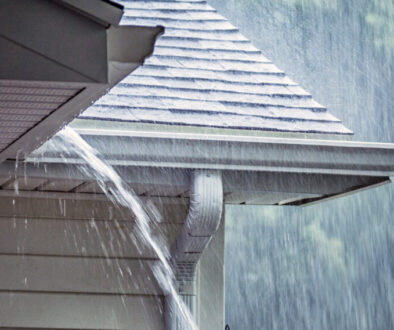
Overflow stains and swollen fascia usually aren’t “random”—they’re the result of a repeat failure point. This is where it helps to recognize the signs your gutters are failing, because patterns like seam drips, sagging, and behind-the-gutter flow tend to show up in the same spots every storm.
This guide helps you spot early warning signs, diagnose what’s actually happening, and know when it’s time to call a pro.
The Simple Rule – Follow the Water Path
A home’s drainage system is a chain. Most water damage happens when one link fails, and water takes the easiest alternate route.
The water path looks like this:
- Roof collects and concentrates water
- Gutters capture runoff and move it horizontally
- Downspouts move volume vertically
- Discharge sends water away from the home
- Soil + grading decide whether it drains safely or becomes a problem
If you’re troubleshooting, don’t start with “Is the gutter dirty?” Start with:
“Is water moving freely from the roof → outlet → downspout → safe discharge?”
If you want a simple, repeatable way to keep that whole chain working through fall storms and leaf drop, the gutter maintenance plan lays out what to check first and how often—so you’re not guessing every time the weather shifts.
Quick Triage – Green, Yellow, Red (DIY vs Pro)
Use this section like a decision filter. You don’t need perfection—just enough clarity to know whether you’re in maintenance mode or problem mode.
Green (Usually DIY / Monitor)
These are common seasonal conditions that rarely indicate damage by themselves:
- Light needles/leaves, but no overflow marks
- Water exits strongly from downspouts during rain
- Minor staining that doesn’t worsen storm to storm
- No standing water in the gutters after rain
What to do:
Do a standard cleanout and a quick rain walkaround. Keep an eye on the same corners as storms pick up.
Yellow (Schedule Service Soon)
These are “not catastrophic” signals that usually worsen if ignored:
- Seam drips that repeat during rain
- Overflow marks or streaking after moderate rain
- One downspout that discharges weaker than the others
- A recurring puddle at a discharge point
- Evidence of water running behind the gutter (wet fascia edge)
What to do:
Clean and test flow. If the same issue repeats after a cleanout, treat it as a system issue (pitch/outlet/hangers), not “more debris.”
If you’re stuck in a pattern where the same corner keeps overflowing or one downspout always looks weak, don’t keep doing the same cleanout on repeat, use the cleaning vs. repair checklist to figure out whether you’re dealing with debris, pitch, hangers, or a seam problem.
Red (Call a Pro Now)
These signs mean you may already be in damage territory:
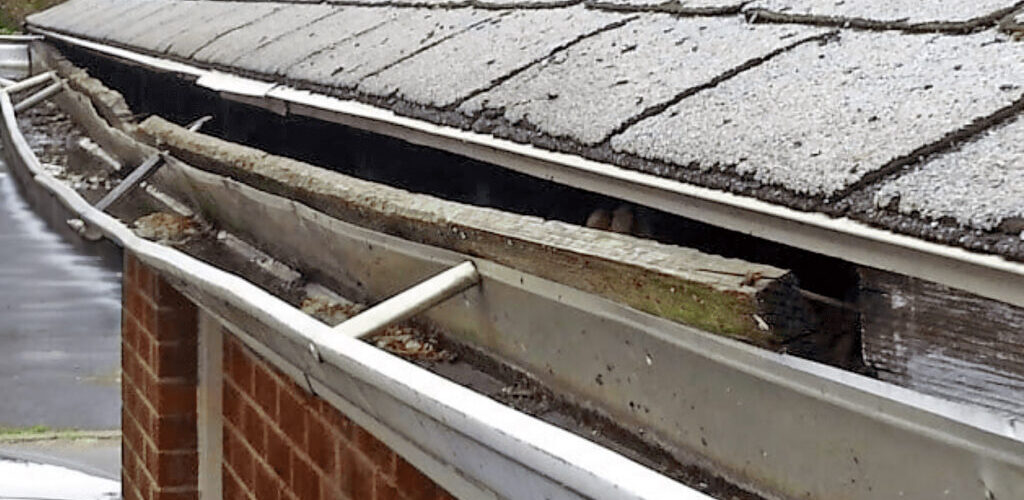
- Soft, swollen, or crumbling fascia (press with a screwdriver tip—if it gives, it’s a problem)
- Gutters pulling away, visible sagging, or sections holding standing water
- Overflow that’s soaking soffits or repeatedly dumping in the same spot
- Foundation pooling, crawlspace dampness, or interior moisture symptoms after storms
- Downspout discharge that backs up even after obvious debris is removed
What to do:
Stop repeating cleanouts. Get the system evaluated and corrected so water stops lingering where it shouldn’t.
What Water Damage Looks Like by Area (and What It Usually Means)
Different symptoms point to different failures. This section helps you interpret what you’re seeing without guessing.
Fascia & Roof Edge Damage (Most Common)
What you’ll see:
- Dark streaks along the fascia board
- Peeling paint or swollen wood
- Rusty fasteners, soft spots, or “mushrooming” wood edges
- Algae or moss thriving along one roofline due to constant moisture
What it usually means:
- Overflow at corners and outlets
- Debris mats holding water against the roof edge
- Improper pitch (water doesn’t move efficiently to the downspout)
- Water running behind the gutter during heavy rain
Why it matters:
Fascia damage tends to spread. Once water starts soaking wood consistently, you’re not just cleaning—you’re fighting rot.
Soffit Stains & Drips
What you’ll see:
- Brown/gray staining on soffit panels
- Drip lines near corners
- Wet-looking soffit edges during or after rain
What it usually means:
- Water is getting behind the gutter (often from overflow, wind-driven rain, or a clogged outlet)
- Splashing or “late dumping” at a corner
- Less commonly: roof leak issues—but many “leaks” blamed on roofing are actually gutter overflow patterns
Quick clue:
If stains worsen specifically during rain and correlate with overflow behavior, it’s usually drainage—not roofing.
Siding & Trim Staining
What you’ll see:
- Vertical streaking on siding
- Dark bands where water repeatedly runs
- Bubbling paint near trim corners
- Mud splash marks after storms
What it usually means:
- Water is dumping off an edge or corner repeatedly
- Downspout discharge is splashing back onto the home
- Water is spilling behind the gutter and reappearing lower on the wall
Why it matters:
Even if the structure is fine, repeated wetting leads to paint failure, rot in trim, and recurring maintenance cycles.
Ground Erosion & Foundation Splash
What you’ll see:
- Trenched mulch beds (like a little river formed)
- Soil displacement at a downspout discharge point
- Splash marks on the foundation
- Pooling water near the perimeter
What it usually means:
- Downspout discharge is too close to the home
- Missing or disconnected extensions
- Water volume is too concentrated (common during the first storms)
- The system backs up and dumps in the wrong place
The big idea:
A functioning gutter system isn’t finished until water lands safely—not just “exits somewhere.”
Crawlspace / Basement Moisture Signals
What you’ll see:
- Musty odor
- Damp insulation or vapor barrier
- Condensation or mold spotting
- Wet soil near perimeter vents
What it usually means:
- Discharge pooling near the home
- Water is migrating along the foundation
- Chronic oversaturation during storm cycles
Note:
This is where “minor overflow” becomes expensive. If you’re getting crawlspace symptoms, you want the drainage pattern corrected quickly.
Why “Clean Gutters” Isn’t Always the Fix
Needles + grit + pollen can form a dense compaction layer that clogs outlets fast—especially after wind events.
A lot of homeowners clean the long gutter run and still deal with overflow. That’s because many gutter failures happen at bottlenecks.
Common bottlenecks:
- Outlet opening (where the gutter meets the downspout)
- Elbow at the top of the downspout (needle/grit trap)
- Downspout run (pinch points, buildup, hidden restrictions)
- Pitch issues (water doesn’t move toward the outlet)
- Hanger spacing / sagging (creates low spots that hold water)
Most of the time, the long gutter run isn’t the problem—it’s what happens at the exit. If you want to confirm the system is actually moving water away from the home (not just “not overflowing”), start with downspouts and drainage and check discharge during rain.
A gutter can look “mostly clear” and still overflow if the outlet is restricted. When water can’t exit freely, it backs up—and backed-up water is what causes most water damage patterns.
The 10-Minute Diagnostic You Can Do During Rain
If you only do one thing from this entire guide, do this: a quick rain walkaround during moderate rain.
Step 1: Watch corners and transitions (2 minutes)
Look for:
- Corner dumping
- Water spilling over the back edge (behind the gutter)
- A single section overflowing while others behave normally
Step 2: Compare downspout discharge (3 minutes)
You’re looking for:
- Strong, steady flow at each downspout
- One downspout that is weak or “late”
- Water backing up at the outlet area
Step 3: Check discharge zones (3 minutes)
Look for:
- Pooling near the home
- Trenching / erosion
- Splash marks on the foundation or siding
Step 4: Take photos (2 minutes)
Photos give you:
- A record of where the system fails
- A way to track whether fixes worked
- A reference you can show a pro (saves time and guesswork)
Once you’ve done one rain check, you’ll usually see whether this is a maintenance issue or a recurring failure.
Rain walkaround rule:
If the same corner fails in multiple storms, you’re not dealing with a one-time clog—you’re dealing with a recurring system issue.
What a Pro Should Check (So You Know You’re Getting Real Service)
When you call someone out, you want more than “we cleaned it.” A real evaluation checks the system end-to-end.
A thorough pro check includes:
- Roof edges and valleys feed debris into gutters (especially shaded sections)
- Full gutter run inspection for low spots, sagging, and seam condition
- Outlet inspection (where most problems start)
- Downspout elbow and vertical run flow confirmation
- Hanger spacing and gutter pitch alignment
- Discharge location and whether water is being sent away safely
- Any signs of fascia damage, soft wood, or repeated behind-gutter flow
If the approach is only “scoop debris and leave,” recurring damage patterns often remain.
What to Do This Week (A Simple Action Plan)
You don’t need a complicated system. You need a repeatable routine that keeps water moving and prevents the “standing water + wet debris” combination.
1) Clear Wet Debris at Choke Points First
Prioritize:
- Corners and low spots
- The first 2–3 feet around downspout outlets
- Any section with visible sediment layers
2) Confirm Discharge
A lot of “water damage” complaints come down to where the water ends up after it leaves the downspout.
Run a hose briefly and confirm:
- Water exits fast at the discharge point
- No backup at the outlet
- No dripping behind the gutter edge
3) Fix Where Water Lands
Even a clean system can cause damage if water dumps in the wrong place.
- Reconnect extensions
- Reposition splash blocks
- Keep discharge away from foundation corners and beds that trench easily
4) Do One Rain Walkaround
You’ll learn more in five minutes during rain than an hour on a ladder in dry weather.
If you want the easiest seasonal cadence to prevent the wet-debris + standing-water combo from returning, follow the fall gutter maintenance checklist—it’s designed around the exact timing when Southern Oregon gutters tend to fail.
FAQs
-
Yes. When outlets clog or debris dams form, water overflows and can run behind the gutter, soaking fascia, soffits, and roof edges over time.
-
If staining worsens during rain and you see overflow, weak downspout discharge, or water running behind the gutter, it’s likely the gutters. Roof leaks more often show up as interior stains that continue even when gutters are flowing normally.
-
Do a short walkaround during moderate rain. Look for corner dumping, water behind the gutter, seam dripping, weak downspout discharge, and pooling at discharge points.
-
Yes, they can when discharge pools near the home or when water repeatedly trenches the perimeter.
-
Recurring overflow usually points to a bottleneck: a restricted outlet/elbow, incorrect pitch, a low spot, or hanger/sagging issues that keep water from moving efficiently to the downspout.
-
Far enough that water doesn’t pool at the foundation or trench landscaping. If you see erosion, splash marks, or recurring puddles near the home, extend or reroute discharge.
-
Call a pro if you have soft/rotting fascia, sagging gutters, persistent standing water, repeat overflow in the same spot after cleaning, or moisture issues near the foundation/crawlspace.