Trench Drains for Driveways & Garages (When They’re Worth It and When They’re Just a Band-Aid)
Key Takeaways
Trench drains work best when the driveway naturally funnels water to one predictable crossing point.
The #1 failure is no clear discharge plan (the drain fills, the pipe can’t move water, and it backs up).
Most “needs a trench drain” situations are actually grading/pitch problems first.
In high-debris areas, trench drains require realistic maintenance (the grate is a leaf/silt magnet).
If water is reaching the garage because the driveway slopes toward it, a trench drain is only “worth it” if it reliably intercepts water and moves it somewhere safe.
A trench drain can be a great solution for garage or driveway water—but only when it’s placed for the water that actually shows up, not just where it looks tidy. The failures I see usually aren’t because trench drains are “bad.” They fail because they get installed as a last-second patch for a bigger issue: bad grading, bad discharge planning, or water that shouldn’t be heading toward the structure in the first place.
In Southern Oregon, winter storms, leaf litter, and sediment turn trenches into debris collectors. If you don’t plan for maintenance and you don’t know where the drain line discharges, a trench drain can become a hidden dam that overflows right when you need it most.
This guide breaks down when trench drains are worth it, where they’re commonly misused, and the field checks I use to determine whether a trench drain is the right tool—or just an expensive way to hide the problem.
If you’re mapping out a full fix (not just treating one symptom), start with drainage and water control in Southern Oregon and work outward from the water source.
What a Trench Drain Actually Does
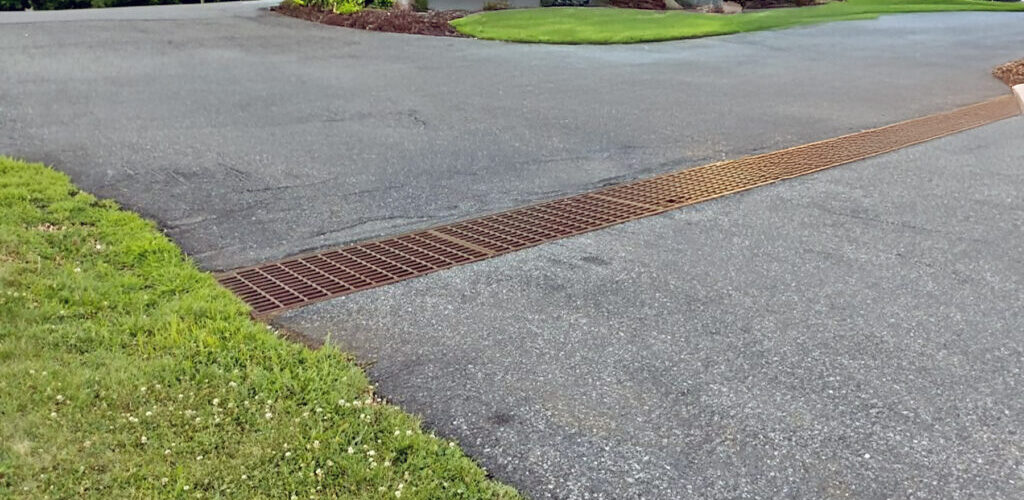
A trench drain is a surface interceptor—a long, grated channel designed to catch water moving across pavement before it crosses a threshold (like a garage slab, shop bay, or downhill door).
Think of it as a “line of defense” for surface flow. It does not fix:
- a garage slab that sits in a low bowl
- a driveway that pitches toward the structure with no runoff route
- hillside or subsurface water pushing up from below
- saturated soil conditions that overwhelm infiltration
If the job is “stop water from crossing this line,” trench drains can be excellent. If the job is “fix why water is here,” you’ll usually need more than a drain.
When Trench Drains Are Worth It
Before you price a trench drain, confirm you’re solving a surface-flow problem—not a low spot or subsurface saturation. The easiest way to tell is to watch where the water actually travels during a decent rain (or look for the dirt lines it leaves behind). If the flow is predictable, a trench drain can be a clean intercept.
1) Water is clearly moving across the driveway toward the garage
If you can see sheet flow (or can predict it by stain lines and silt trails), a trench drain can intercept it—if it spans the full flow path.
Inspector clue: look for sediment fans, staining, and “clean stripes” where water repeatedly travels.
2) There’s one logical intercept line
Trench drains perform best when there’s a clear “capture line,” like:
- across a garage door opening
- across a driveway apron where water crosses
- at the base of a slope before a slab/door
If the water is arriving from multiple directions or pooling broadly, a trench may become a partial fix at best.
3) You have a real discharge plan (not just hoping it soaks in)
A trench drain is only half a system. The other half is: Where does the captured water go?
If the drain line doesn’t have adequate slope, capacity, or a safe outlet, the trench becomes a holding trough.
For regional stormwater design guidance and discharge considerations, the Rogue Valley Stormwater Quality Design Manual is a solid reference point.
4) The garage or slab is otherwise in decent shape
If the slab is already below the surrounding grade or the driveway directs water into a “bowl,” trench drains can help—but you’re often treating symptoms. In those cases, evaluate grading first.
When Trench Drains Are Usually Not Worth It
Before you default to a trench drain, zoom out and ask why the driveway is sending water toward the garage in the first place. If the pitch is wrong, the drain becomes a permanent “catcher’s mitt” that has to perform perfectly every storm.
Any clog, ice, or sediment buildup turns it right back into a flooding problem. When correcting the slope is feasible, it’s usually the cleaner long-term fix.
1) You’re using it to compensate for bad driveway pitch
If the driveway slopes toward the garage, a trench drain can work, but it’s doing constant heavy lifting. If slope correction is possible, that often beats relying on a drain that must stay clear all winter.
2) There’s no safe place for discharge
If you can’t identify a safe, legal, non-nuisance discharge point, the trench drain is just intercepting water to… store it temporarily.
3) The site is a high-debris or high-sediment zone and maintenance won’t happen
If your driveway area collects needles/leaves and the grate isn’t cleaned, water will jump the trench. This isn’t a theory—it’s one of the most common failure stories.
4) The problem is subsurface water or saturation
If the garage area stays wet long after storms, or water appears without obvious surface flow, you may be dealing with subsurface issues. In those cases, start with the diagnosis framework you use for surface vs underground drainage.
The Quick Decision Test (Field-Friendly)
Use this before you commit:
- If you can see water moving across pavement toward the garage: a trench drain may be appropriate.
- If water pools broadly near the slab/door: check pitch and low spots first.
- If the area stays soggy 24–72 hours after the last decent rain: investigate subsurface saturation (a trench drain won’t fix that).
- If you can’t name the discharge location and path: you don’t have a trench drain plan yet.
Rule of thumb: A trench drain is “worth it” when it reliably intercepts flow and the system can discharge it somewhere safe in real storms.
Common Failure Points (What I Actually See)
1) “It drains, but it still floods”
Usually means:
- the trench isn’t spanning the full flow path, or
- water is arriving from another direction, or
- the outlet pipe can’t keep up under heavy flow
2) The drain turns into a debris dam
Leaves, needles, and silt build up at the grate. Water sheets over the top and crosses the threshold anyway.
3) Outlet line is undersized, crushed, or poorly sloped
Even if the trench itself is fine, the outlet line becomes the choke point. The trench fills, then overflows.
4) Discharge location is wrong
I see drains that discharge:
- onto the driveway (back where it started)
- into a saturated area with no fall
- into a spot that erodes and silts up the outlet
5) Freeze isn’t the issue—mud is
In Southern Oregon, it’s usually not freezing that kills trench drains. It’s sediment + organics creating a slow-motion clog that shows up during the first big storm.
Pros and Cons (Short Version)
At this point, the goal isn’t to “sell” trench drains—it’s to be honest about what they do well and what they demand in return. Here’s the short version I use when homeowners want the bottom line before getting into layout and discharge details.
Pros
- Excellent at intercepting predictable surface flow
- Can protect garage slabs and reduce interior water intrusion risk
- Can prevent ice/slick areas if it controls winter runoff path (site-dependent)
Cons
- Requires regular cleaning in debris zones
- A trench is only as good as its discharge plan
- Can be a band-aid for pitch/grading problems if used alone
Comparison Table: Trench Drain vs Other Fixes
| Problem | Trench Drain Helps? | Better First Step |
|---|---|---|
| Sheet flow crossing driveway into garage | Yes | Often trench drain + confirm discharge |
| Driveway pitches toward garage (constant runoff) | Sometimes | Regrade/pitch correction if possible |
| Water pools in a low spot near slab | Sometimes | Fix low spot / improve pitch / add surface drainage |
| Yard saturation / seepage / wet for days | No | Diagnose subsurface water strategy |
| Downspout dumping at driveway edge | Indirectly | Fix downspout discharge distance and routing first. |
Install Concepts That Prevent Most Failures (High Level)
Keeping this homeowner-safe and non-engineering:
- Span the full flow path. Partial coverage is the fastest way to get “it still floods.”
- Plan the outlet like it matters. Because it does. Know where water exits and what it does next.
- Design for maintenance. If you won’t clean the grate, you’re buying a debris trap.
- Avoid “dead flat” outlet piping. Low slope + sediment = slow clog.
- Protect the discharge area. If the outlet scours soil, it will eventually undermine performance.
When It’s a Red Flag
Bring in a pro when:
- water reaches the garage interior or adjacent crawlspace (active intrusion)
- the driveway/garage area behaves like a bowl (requires grading evaluation)
- you can’t identify a safe discharge route
- there are retaining walls, slabs, or foundation-adjacent grade constraints
- the problem looks like subsurface seepage rather than surface flow
When to Call a Pro
It’s time when you need someone to evaluate the full path:
source → flow path → intercept point → outlet capacity → discharge location
That’s usually where trench drain projects succeed or fail.
Final Field Note
A trench drain is worth it when it does one job extremely well: intercept surface flow and direct it to a safe location. Most failures happen when it’s installed to “make the water disappear” without a discharge plan—or to compensate for a driveway that’s pitched the wrong way.
If you can see the water path and you can explain where the captured water will go during a hard storm, a trench drain can be a clean, reliable upgrade.
FAQs
-
Often, yes—when the flooding is caused by surface water crossing the threshold and the drain has a reliable discharge path.
-
Most overflow comes from clogged grates, undersized or poorly sloped outlet piping, or no safe discharge route during heavy storms.
-
Yes. In debris zones, trench drains need periodic clearing so leaves and sediment don’t block flow.
-
Usually outside at the threshold line, but placement depends on where water actually crosses and whether the drain can intercept the full flow path.
-
Sometimes, but it’s often a band-aid. If the driveway pitches water toward the garage, correcting pitch may be more reliable long-term.
-
That points to subsurface saturation or seepage—trench drains handle surface flow, not groundwater problems.