Rain Chains vs Downspouts (and Do They Work in Heavy Rain?)
Key Takeaways
Rain chains can work well in light-to-moderate rain, but heavy rain + wind is where problems show up fast.
The real question isn’t “rain chain or downspout?”—it’s where that concentrated roof runoff lands.
If you already have wet corners, trenching, splash marks, or pooling, rain chains can make symptoms worse unless routed correctly.
The most reliable setup in Southern Oregon is often a hybrid: rain chain for looks + a controlled landing zone (basin/rock bed/drain).
A 5–10 minute walkaround during moderate rain will tell you more than any dry-day inspection.
Rain chains look great. They’re quieter, more decorative, and they feel like an elegant solution compared to a plain downspout.
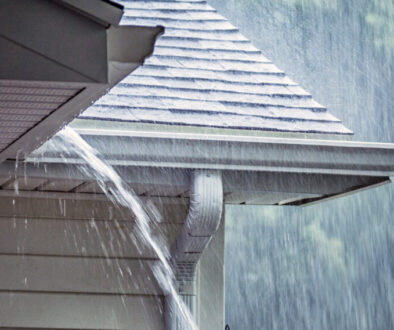
But Southern Oregon doesn’t just get gentle rain. During storm cycles—especially with wind—your roof can dump a surprising amount of runoff fast.
This guide breaks down when rain chains work, when they don’t, and how to set them up so water doesn’t come right back to your foundation.
The Goal Isn’t “Pretty” (It’s Controlled Discharge)
A downspout does two jobs:
- Moves water down
- Moves water away
A rain chain can do the first job (moving water down) some of the time. The second job (moving water away) is where most issues begin.
If you’ve ever seen mulch beds trench, a foundation band stay damp for days, or puddles show up at one corner after storms, you’re dealing with a discharge pattern problem—not just “rain.”
Before you change anything, it helps to understand what “good discharge” looks like in real rain. Our guide to downspout discharge and drainage in Southern Oregon explains the simple signs of splashback, pooling, and corner saturation.
What Rain Chains Are (and What They Replace)
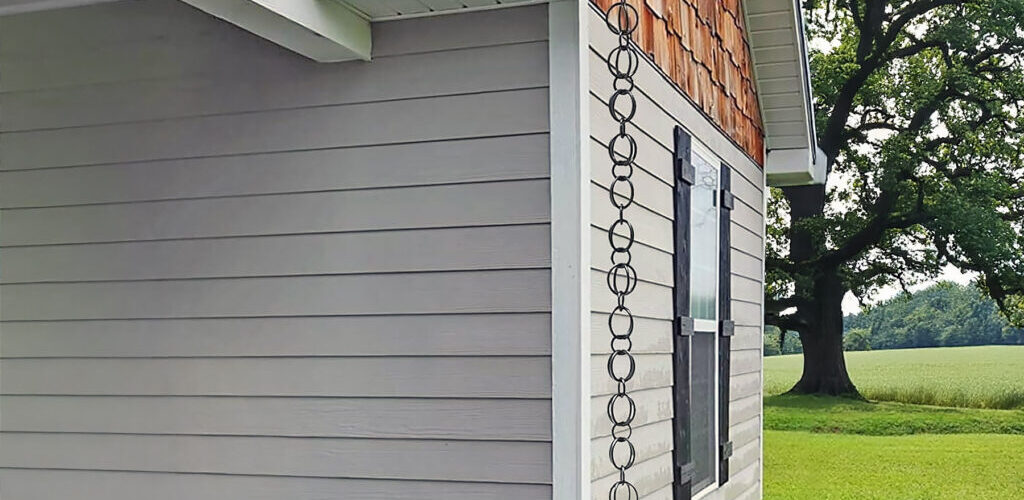
Rain chains replace the vertical downspout section, not the gutter itself.
Instead of sending water down a closed pipe, the gutter outlet feeds water into:
- a linked chain,
- cups, or
- a decorative channel-style chain.
The key difference: rain chains are open-air systems. That means wind, volume spikes, and splash are part of the equation.
Do Rain Chains Work in Heavy Rain?
Sometimes, but not by default.
Most problems aren’t the chain itself—they’re the outlet volume and the landing zone underneath it.
Rain chains tend to work best when:
- the roof section feeding them is small
- eaves are sheltered from the wind
- the gutter outlet is not a major valley dump point
- there is a stable landing zone that keeps water moving away
They tend to fail when:
- multiple roof planes dump into one corner
- storms arrive in short bursts
- wind pushes water sideways
- the landing zone is mulch, flat soil, or near the foundation
- the system is expected to handle “downspout-level performance” without drainage support
Simple rule: rain chains can be a great feature—but they’re not a substitute for proper water routing.
The 3 Most Common Failure Points
1) Splashback Onto Siding, Fascia, and the Foundation
With a downspout, water exits at ground level in one direction. With a rain chain, water often arrives as:
- a broken stream,
- droplets, or
- a spray in the wind.
That spray can hit:
- siding
- trim
- windows
- foundation walls
If you ever see a “wet band” on the foundation after storms, that’s a warning that water is landing wrong and coming back toward the house.
2) Overflow at the Gutter Outlet (or Bypassing the Chain)
In heavy rain, water can overwhelm the outlet area.
If the outlet or top elbow area is even slightly restricted, water backs up and takes the easiest alternate route—often over a corner or behind the gutter line.
If you’re already seeing repeat corner problems, the issue may be bigger than the “down” portion of the system. In some cases, it’s actually roof-edge routing. Here’s a helpful reference if you suspect behind-the-gutter flow: Drip edge and gutter aprons: what they do and when they matter.
3) Bad Landing Zone (The Most Important One)
This is where most rain chain installs go wrong.
If the chain drains into:
- a mulch bed,
- flat compacted soil,
- a corner with a negative slope,
- or a spot close to the foundation,
you’ll often get:
- trenching / erosion,
- puddling,
- algae/moss along the foundation,
- damp crawlspace smell during rainy weeks.
If you’re not sure whether you’re dealing with ground slope vs gutter routing, this breakdown makes it simple: How to tell if you have a grading problem (or a gutter problem).
The “One Corner” Rule Applies Here Too
If one corner is always the wettest spot—same puddle, same trenching, same damp band—treat it like a high-volume exit point, not a cosmetic issue.
That corner probably receives concentrated runoff from:
- multiple roof planes,
- a valley,
- or a long gutter run.
Rain chains can work beautifully on low-volume sections. They struggle at “collection corners.”
What a Good Rain Chain Setup Looks Like in Southern Oregon
A rain chain works when it drains into a landing zone that can handle volume and keep water moving away.
Better Landing Zone Options (Common “Works Well” Setups)
- Rock bed + splash block (simple, stable)
- Catch basin tied to a drain line (best performance)
- Decorative basin with overflow path (looks good, handles spikes)
- French drain inlet (when properly designed)
What to Avoid
- loose mulch beds
- soil that trenches easily
- any spot where water can turn back toward the foundation
- discharge zones within a few feet of the house on flat ground
If you’re deciding “how far is far enough,” this guide keeps it practical: Downspout extensions: how far should water discharge from the house?.
The 5–10 Minute Storm Test (Best Diagnostic)
You don’t need a ladder. Pick a moderate rain and check three things:
1) Corner Behavior
- Is anything overflowing?
- Does water look like it’s going behind the gutter line?
2) Chain Behavior
- Is the water staying “on” the chain?
- Or is it spraying sideways / breaking into droplets?
3) Landing Zone Behavior
- Is water flowing away?
- Any pooling within a few feet of the foundation?
- Any trenching starting right away?
If you want to connect rainfall patterns to the problems you’re seeing, this is a useful reference for context: How much rain does the Rogue Valley actually get?.
Rain Chains vs Downspouts (A Practical Recommendation)
In most Southern Oregon neighborhoods, the most reliable approach is:
- Use rain chains on low-volume sections where you can control the landing zone.
- Use downspouts (or hybrids) on high-volume corners where the goal is performance first.
A hybrid setup might look like:
- Rain chain for aesthetics
- Catch basin below
- Underground drain / tight routing away from the foundation
That gives you the look and the reliability.
When to Call a Pro
Rain chains are a “small change” that can accidentally create repeat wetting patterns.
Call a pro if you see:
- persistent wet fascia / peeling paint near the gutter line
- water running behind the gutter during storms
- trenching or erosion that repeats every rainy cycle
- pooling near the foundation that doesn’t improve with routing
- musty crawlspace smell that spikes during rainy weeks (see crawlspace moisture in Southern Oregon)
The goal isn’t to make it look better for one storm—it’s to stop the pattern that causes long-term damage.
FAQs
-
They can, but heavy rain exposes weak points fast—especially splashback and overflow. They work best on smaller roof sections with a controlled landing zone.
-
Yes, if water splashes back, pools near the perimeter, or trenches soil that redirects water toward the home. The landing zone matters more than the chain itself.
-
Ideally into a stable landing zone: rock bed, splash block, basin, or a drain inlet. Avoid dumping into mulch beds or flat soil near the foundation.
-
Not universally. Rain chains are great for aesthetics and light-to-moderate flow, but downspouts are more reliable for high-volume corners and wind-driven storms.
-
A hybrid approach: rain chain for the visible section, paired with a basin or drain that routes water away efficiently—especially on corners that collect runoff.