Pop-Up Emitters vs Daylight Discharge (Pros, Cons, and Failure Points)
Key Takeaways
-
Daylight discharge is usually the most reliable because you can see it working (or failing) in real time.
-
Pop-up emitters look cleaner but fail more often in low-slope lines and muddy/soggy outlet areas.
-
Most “drainage failures” happen at the termination point, not in the middle of the pipe run.
-
If you don’t control sediment and debris upstream, expect the classic “worked for a year… then stopped” problem.
-
A good setup answers one question clearly: Where does overflow go during a hard storm?
Pop-up emitters and daylight discharge are two common ways to end a buried drain line—usually a downspout line, yard drain, or the outlet of a French drain. Both can work well, but they fail in different ways, and most “mystery puddles” I see trace back to one thing: the termination point was chosen for looks, not reliability.
If you’re building a full drainage plan (not just fixing one outlet), start with our Drainage in Southern Oregon guide and work outward from the water source.
In Southern Oregon, winter saturation, leaf litter, and fine sediment make these outlets behave differently than they do on paper. Systems that seem fine in light rain can back up during the first real storm because the outlet can’t pass water fast enough—or because it’s stuck closed.
This guide is written from a practical inspection viewpoint: what I look for, what usually fails first, and how to choose an outlet you can verify in the field. Also, here, the term “drain line” refers to a buried line that carries stormwater from a downspout, yard drain, or French drain outlet.
What a Pop-Up Emitter Actually Does
A pop-up emitter is basically a springless cap at the end of a drain line. When enough water pressure builds, the cap lifts and releases water at the surface. When flow stops, it closes to keep debris out (in theory).
Pros (when the site cooperates)
-
Clean look: nothing visible until it’s flowing
-
Can be useful when you can’t safely daylight without creating erosion or nuisance discharge
-
Keeps some surface debris from falling into an open pipe
The failure points I see most often
1) Not enough slope (the cap never reliably opens)
Pop-ups need a little “push.” If the line is mostly flat, water dribbles, the cap barely lifts, and the system behaves like it’s clogged even when it isn’t.
2) The outlet sits in the lowest, soggiest spot
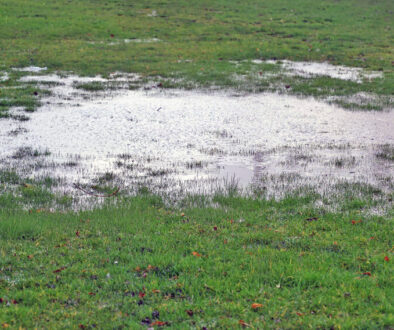
This is the classic misapplication: the emitter is installed right where water already wants to pond. The area turns muddy, the cap gets packed with fines, and the outlet becomes a permanent soft spot.
3) Sediment and organic debris bind the cap
Fine grit, roof granules, needles, and decomposing leaf fragments can keep the cap from seating or opening. This is the source of the “worked for a year… then stopped” stories.
4) Turf and landscaping swallow it
Mulch, thatch, roots, and overgrown grass can effectively bury the emitter. If you can’t find the outlet, you can’t verify it.
5) Physical damage
Mowers, foot traffic, and routine yard work can crack or deform the emitter, leading to sticking or leakage around the base.
What Daylight Discharge Actually Does
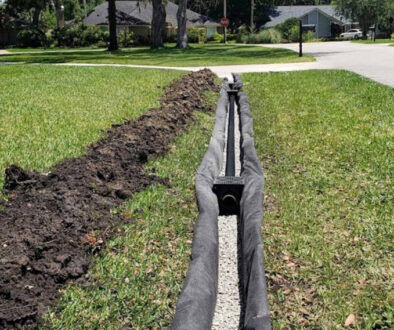
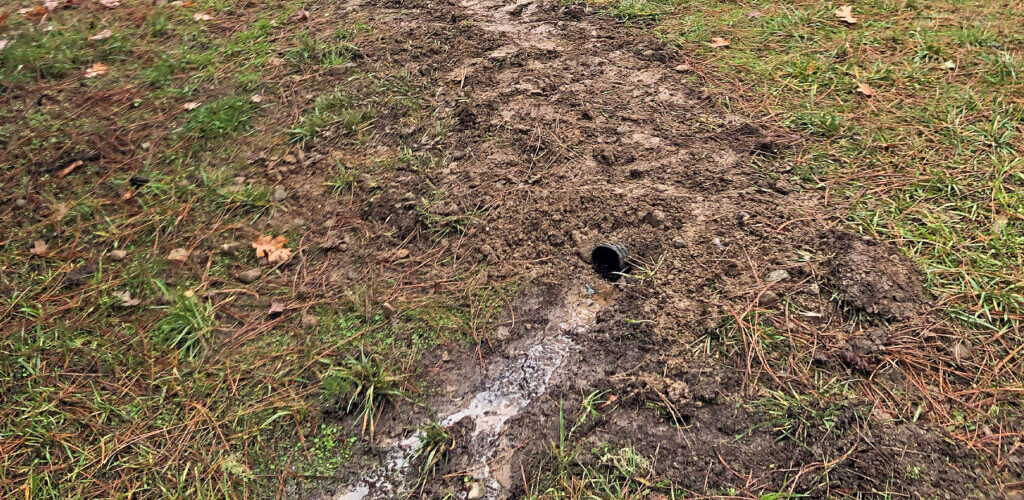
Daylight discharge is the simplest version: the pipe ends at a location where water can exit at grade and flow away visibly.
Pros (why it’s often the “inspector favorite”)
-
Inspectable: you can confirm flow during rain or with a hose test
-
Diagnosable: if it’s blocked, you’ll usually see it
-
Less likely to hide a problem until it shows up at the foundation
-
Typically handles bigger volumes better, especially for roof runoff
The failure points I see most often
1) Erosion/scour at the outlet
Concentrated flow can carve a channel, undermine the end of the pipe, or create a muddy trench—especially during hard storms.
For regional stormwater design guidance (including common outlet and discharge considerations), the Rogue Valley Stormwater Quality Design Manual is a solid reference point.
2) Bad outlet location (creates a new problem)
Discharging onto a walkway, driveway, neighboring property, or a slope that washes out is a layout failure, not a pipe failure.
3) Outlet becomes blocked
Animal activity, roots, leaves, and collapsed soil can plug the end. If the opening is unprotected and sitting low, it’s easy to bury.
4) Outlet sits in a zone that floods
If the discharge area goes underwater during storms, the outlet can’t move water efficiently. Depending on the setup, it may back up into the line.
The “Looks vs Reliability” Rule
Here’s the pattern I see:
-
If the homeowner prioritizes hidden drainage, pop-ups get chosen.
-
If the yard has low slope, seasonal saturation, or debris, pop-ups become unreliable.
-
Daylight discharge can look “less tidy,” but it’s easier to keep honest because you can see the result.
If you want one principle that prevents repeat problems, it’s this:
Pick an outlet you can inspect without guessing.
Southern Oregon Reality Check
In Southern Oregon, the system you install has to work during the conditions that actually show up: long wet stretches, saturated soil, and debris moving through the system.
A few local realities that matter:
-
Winter storms can saturate soil so heavily that surface areas stay soft for days.
-
Fine sediment and organics accumulate faster than most homeowners expect.
-
Neighborhood soils vary—two homes a mile apart can behave completely differently.
-
If your yard stays spongy long after storms, you may be fighting the wrong battle entirely (see surface vs underground drainage).
The Quick Decision Test (Field-Friendly)
Use this before you commit to an outlet type:
Choose Daylight Discharge when…
-
You have a safe downhill location where water can exit and continue away
-
You want the system to be easy to verify during storms
-
The line carries higher volume (like multiple downspouts)
-
You want fewer moving parts and fewer “mystery failures”
Choose a Pop-Up Emitter when…
-
You cannot safely daylight without creating erosion, a nuisance flow, or an obvious outlet in a bad location
-
The line has enough slope to open the cap consistently
-
The outlet can be placed in an area that dries out between storms (not a perennial low spot)
-
You’re willing to keep the system “clean water” upstream
Red flag: either option fails if…
-
You don’t have a clear answer to: Where does overflow go when the system is overwhelmed?
-
The yard stays wet for days even after rain stops (that’s often not a simple runoff problem)
Comparison Table: Pop-Up Emitters vs Daylight Discharge
If you’re choosing between these two, here’s the simplest way to think about it: Daylight discharge is easier to verify. Pop-ups are easier to hide—but they’re also easier to ignore until they back up.
| Factor | Pop-Up Emitter | Daylight Discharge |
|---|---|---|
| What it is | A capped outlet that “pops” open under flow/pressure | A visible pipe outlet that drains to open air at grade |
| Best use case | When you can’t safely outlet at the surface in a visible spot | When you have a safe downhill location and want a verifiable outlet |
| Reliability in heavy winter storms | Moderate (depends heavily on slope + clean outlet area) | High (simple, fewer moving parts) |
| Most common failure point | Cap binds/sticks from sediment + organics; outlet becomes muddy | Outlet gets blocked/buried or causes erosion if unprotected |
| What you’ll notice when it fails | Water backs up at inlet, pooling appears “out of nowhere,” emitter doesn’t lift | Reduced/no flow at outlet; water backs up at inlet during storms |
| Sensitivity to low slope | High (needs enough push to open consistently) | Lower (still needs fall, but less finicky) |
| Sensitivity to debris/sediment | High | Medium (still blocks, but easier to spot and clear) |
| Maintenance reality | Must stay findable; cap + outlet area need to stay clean | Check outlet opening, clear debris, monitor erosion |
| Risk of hiding problems | Higher (can fail silently until backup) | Lower (failure is visible sooner) |
| Erosion risk | Usually lower at the outlet (dispersed flow), but can create a muddy bowl | Higher if flow concentrates without protection |
| “Inspector preference” (most homes) | Good only when conditions are right and owner will monitor it | Often the better default if the site allows a safe outlet |
Which Should you Choose?
If you can’t discharge to daylight safely and you’re considering infiltration instead, read this first: dry wells in Southern Oregon (when they work—and when they don’t).
If you have a safe downhill spot where water can exit without causing erosion, nuisance flow, or a neighbor issue, daylight discharge is usually the most reliable choice—it’s simple and you can verify it during a storm.
Choose a pop-up emitter when you can’t daylight safely or visibly, but only if the drain line has enough slope to open the cap consistently and the outlet won’t sit in a soggy low spot where mud and sediment build up.
Either way, the “correct” choice is the one that answers this clearly: when the system is overwhelmed, where does the overflow go?
Failure Clues I Use During an Inspection
If you’re troubleshooting an existing setup, these signs usually tell the story:
Signs the problem is near the outlet
-
Water backs up at the inlet only during heavier rain
-
The pop-up doesn’t lift even when the line is clearly carrying water
-
The discharge area is muddy, sunken, or constantly soft
-
You see pooling “out of nowhere” halfway along the run (water is surfacing where it can)
Signs the problem is in the pipe run
-
A consistent wet stripe follows the line route
-
A section of yard sinks or stays unusually soft (often a crushed/settled section)
-
The system worked until a vehicle drove over the route or trench settled hard
Signs it’s not the drain line at all
-
Water is visibly flowing across the surface toward the home (start with grading)
-
The yard stays saturated long after storms (possible subsurface saturation / perched water)
-
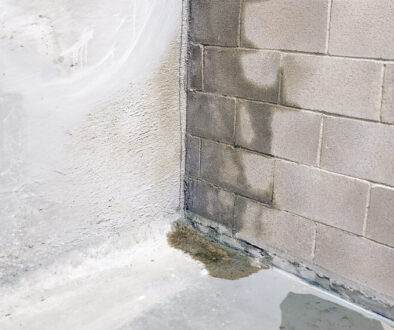
You’re treating a foundation moisture issue with an “end-of-line” solution
Install Concepts That Prevent Most Failures (High Level)
Keeping this homeowner-safe and non-engineering:
-
Debris control upstream matters more than people think. Roof runoff carries grit and organics—this is why consistent gutter maintenance in Southern Oregon prevents a lot of outlet failures.
-
Slope is not optional for pop-ups. Marginal fall leads to inconsistent opening and chronic backups.
-
Don’t place the outlet in the wettest spot. Put the termination where it can dry out and stay findable.
-
Make the outlet testable. If you can’t confirm flow during a rain or hose test, you’re flying blind.
-
Protect daylight outlets from erosion. If water exits with force, it needs a plan so it doesn’t carve a channel.
-
Have an overflow plan. Systems should fail “safely,” not at the foundation.
When It’s a Red Flag
Bring in a pro when:
-
Water reaches a crawlspace, garage, or interior
-
You can’t identify a safe discharge location that won’t create a new hazard
-
The site involves retaining walls, slabs, tight clearances, or foundation-adjacent grading changes
-
You suspect hillside seepage, perched water, or seasonal groundwater
-
Multiple downspouts/drains are tied together and the routing is unknown
When to Call a Pro
It’s time to bring in help when:
-
You need to confirm whether the issue is roof runoff vs subsurface water
-
The system fails during every big storm despite “fixes”
-
You want someone to evaluate the whole path (roof → gutter → downspout → line → outlet → discharge area)
-
You can’t confidently answer where overflow goes when capacity is exceeded
Final Field Note
Most drainage “fixes” don’t fail because the idea was wrong. They fail because the outlet was placed where water can’t reliably leave during real weather.
If you want the most repeatable win: choose the termination method you can inspect, and design for the storm that actually happens—not the average drizzle.
FAQs
-
Yes—when the line has enough slope, the outlet isn’t sitting in a soggy low spot, and debris is controlled upstream.
-
Most failures come from sediment and organic buildup binding the cap, low slope that can’t lift it consistently, or an outlet area that turns into a muddy basin.
-
Often, because it’s simpler and inspectable—but only if the outlet location is safe and you manage erosion where water exits.
-
Backups at the inlet during rain, bubbling or pooling along the pipe route, or a pop-up that never lifts during steady flow can point to a blockage or a crushed section.
-
Yes. Concentrated flow can scour soil in heavy storms, so the outlet area often needs basic protection to prevent washouts.
-
Sometimes, but combined volume increases overwhelm risk and makes failures harder to diagnose—especially when slope is marginal.