Hillside Drainage: How to Handle Seepage on Sloped Lots
Key Takeaways
-
Hillside seepage is usually a subsurface water problem (not something a surface drain “catches” once and fixes).
-
Most failed hillside fixes move water without a clear plan for where it discharges in a hard storm.
-
A French drain can work, but only when it’s designed as interception + conveyance, not “bury gravel and hope.”
-
If the area stays wet 24–72 hours after the last decent rain, plan for a subsurface strategy—not just grading tweaks.
-
If water is reaching a crawlspace, slab edge, or retaining wall, it’s time to treat this as a structure-adjacent drainage issue.
What Hillside Seepage Usually Means
On sloped lots, seepage typically shows up when water moving through soil hits a change in conditions—like compacted fill, a clay layer, bedrock, or a cut slope—then redirects sideways until it finds daylight. That “daylight” is often your yard, a slope break, the back of a retaining wall, or the base of a foundation.
This is why hillside seepage can be confusing: you may not see obvious surface runoff, but the ground stays wet, soft, or actively weeping.
In Southern Oregon, seepage is often worst after a few consecutive rainy days—when the soil loses storage capacity and starts moving water laterally.
If you want the big-picture framework for diagnosing these scenarios, start with the Drainage and Water Control in Southern Oregon guide before you pick a specific fix.
Surface Water vs Subsurface Water On Sloped Lots
When I’m trying to figure out whether a homeowner needs surface drainage, subsurface interception, or both, I’m looking for timing and repeat patterns:
-
Surface Runoff: shows up during rain and follows visible paths (sheet flow, channels, staining).
-
Subsurface Seepage: shows up during/after storms and can linger—often worst after multiple wet days in a row.
If you’re on the fence, this quick explainer helps you separate surface drainage from underground drainage before you start trenching.
Common Signs You’re Dealing With Hillside Seepage
-
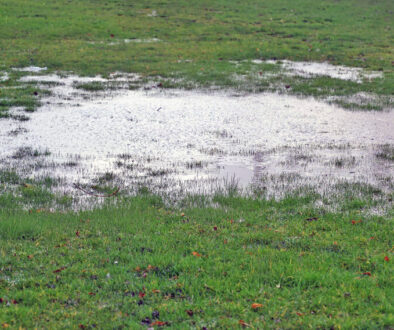
A wet zone that persists 24–72 hours after the last decent rain
-
“Weeping” at a cut slope, slope break, or hillside toe
-
Muddy patches that appear even when the surface looks graded correctly
-
Water collects behind a retaining wall or pushes through joints
-
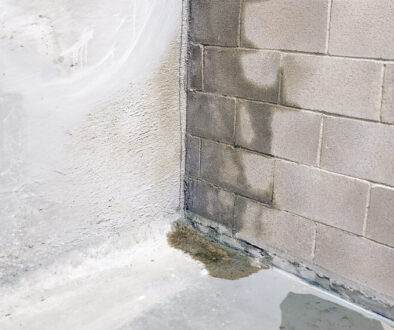
Damp crawlspace odors, efflorescence, or staining along the lower wall
-
A recurring wet stripe that tracks parallel to the slope
What Actually Works For Hillside Seepage
Interception Drainage (Catching Water Before It Reaches The House)
This is the core concept: you’re not trying to dry the whole hill—you’re trying to intercept moving subsurface water and redirect it to a safe discharge point.
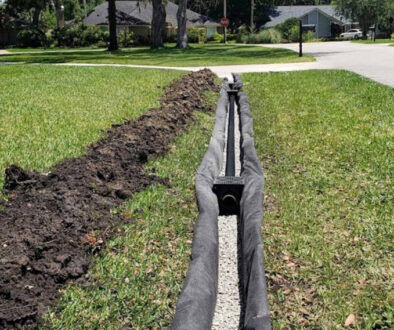
In practice, this is often a French drain–style approach—especially when you can identify a consistent seepage band upslope. If you want the basics (and what “good” looks like in our region), start with French drains in Southern Oregon.
Conveyance (Moving Water Reliably To A Safe Exit)
Interception without conveyance is where most hillside systems fail. The question isn’t “Can I catch it?”—it’s:
Where does it go when the soil is saturated, and the storm is still going?
Discharge Planning (The Make-Or-Break Step)
A hillside fix is only as good as its discharge plan. If discharge is vague (“it’ll soak in”) or impossible (“there’s nowhere to send it”), you’ll see repeats: soggy zones, blowouts, or water rerouting toward the structure.
When A French Drain Works (And When It Doesn’t)
When It Works
-
You can identify a consistent seepage band or wet zone
-
You can intercept the upslope of the problem area
-
You have a safe discharge route that stays functional in heavy rain
-
The system can be maintained (cleanouts, accessible path)
When It Doesn’t
-
It’s installed as a “gravel trench” with no reliable outlet
-
The slope sends sediment and organics into the system with no control
-
The area is already saturated for long periods (little capacity to accept more water)
-
The root cause is structural (retaining wall design, slab elevation, drainage plane issues)
The Quick Decision Test (Field-Friendly)
Use this before you dig anything:
-
If water appears during rain and you can see it moving, start with surface flow control (grading, swales, hardscape pitch).
-
If wet zones linger 24–72 hours after the last decent rain, plan for subsurface interception (seepage is likely).
-
If the wet zone is uphill from the house and “feeds” the foundation area, you likely need interception + conveyance.
-
If you can’t explain discharge in a hard storm, you don’t have a plan yet.
Common Failure Points (What I Actually See)
Before we get into specific fixes, it helps to know where hillside drainage projects usually go sideways. In my experience, most “failed systems” aren’t missing pipe or gravel—they’re missing a clear answer to one question: where does the intercepted water go during a hard storm? That’s why the first failure point is almost always the same.
No Real Discharge Plan
The drain “works” until the first big storm, then backs up because water has nowhere to go.
Interception Too Late
Systems installed right at the foundation often fail because they’re trying to fix the symptom after water already reached the structural zone.
Sediment And Organics Build-Up
Needles, silt, and fines accumulate over time. Without realistic maintenance and debris control, capacity drops.
Mixing Roof Runoff Into A Seepage System
Roof runoff can overwhelm an interceptor drain quickly if it’s not planned for. If roof water is part of the issue, fix the discharge behavior first—most of the time that starts with downspout discharge distance and routing.
Treating Infiltration As Universal
Some soils and seasonal conditions simply don’t infiltrate fast enough. When infiltration is the plan, it needs to be realistic for your site (and have overflow).
If you’re considering infiltration as an alternative to discharge, treat it like its own decision—not a default. This breakdown of dry wells in Southern Oregon covers when infiltration works, when it fails, and why overflow planning matters.
Install Concepts That Prevent Most Failures (High Level)
-
Start upslope of the problem, not at the symptom.
-
Design for inspection: you should be able to confirm flow and service access points.
-
Separate water types: don’t combine roof runoff and seepage unless you’re confident the outlet capacity supports it.
-
Think in storms, not averages: hillside seepage is worst after long wet stretches.
-
Plan overflow behavior: systems should fail “safely,” not toward the structure.
When It’s A Red Flag
Bring in a pro when:
-
Water reaches a crawlspace, slab edge, or interior (active intrusion)
-
The seepage zone is interacting with a retaining wall or steep cut slope
-
You’re seeing movement/cracking that may be tied to saturated soils
-
You can’t identify a safe discharge location
-
The fix would require digging near foundations, footings, or structural elements
When To Call A Pro
It’s time when you need someone to evaluate the full path:
source → subsurface flow path → interception zone → conveyance → discharge → overflow behavior
That “whole-path” thinking is what separates a one-time fix from a repeat project.
Final Field Note
Most hillside drainage failures come down to one thing: the system moves water without a plan for where it goes when the hill is saturated.
If you can identify the seepage band, intercept it early, and discharge it safely, hillside seepage can be managed.
If discharge is unclear, you’re usually better off pausing and diagnosing rather than burying an expensive guess.
FAQs
-
Usually subsurface water moving through soil until it hits a restrictive layer or slope change, then “daylights” as seepage at the surface or near foundations.
-
Sometimes. It works best when you can intercept the seepage zone upslope and you have a reliable discharge path.
-
Because soil becomes saturated and loses storage capacity, so more water moves laterally through the hillside instead of soaking in.
-
Only if the problem is surface runoff. If the ground stays wet long after rain stops, grading alone usually won’t solve it.
-
To a safe location where water can exit without creating erosion, nuisance flow, or returning toward the structure—especially during heavy storms.
-
If water is reaching the crawlspace/garage/interior, if there are retaining walls or steep slopes involved, or if discharge planning isn’t clear.