How to Tell If You Have a Grading Problem (or a Gutter Problem)
Key Takeaways
- If water shows up only at one downspout corner, it’s usually a discharge/routing issue—not “bad grading everywhere.”
- If the whole side of the house stays wet after rain, grading/soil conditions are often the driver.
- The fastest diagnostic is a 10-minute walkaround during moderate rain.
- “Clean gutters” doesn’t fix problems caused by flat ground, compaction, or negative slope.
- When in doubt, follow the chain: roof → gutter → downspout → discharge → ground.
When you see puddles near the foundation, trenching in mulch beds, or a musty crawlspace during rainy weeks, it’s tempting to blame “grading.” But a lot of Southern Oregon water problems start one step earlier: where the gutters and downspouts dump water.
The key is to figure out whether you’re dealing with:
- a gutter/downspout problem (water isn’t moving correctly through the system),
- a discharge problem (water exits fine but lands in a bad spot), or
- a grading/soil problem (the ground can’t move water away even with good discharge).
This guide gives you simple “tell-tales” so you can stop guessing and fix the right thing.
If you’re also seeing overflow streaks, wet fascia edges, or repeated corner dumping, it helps to zoom out and look at the downstream damage patterns in water damage from gutters & roof runoff in Southern Oregon.
The Simple Rule: Follow the Water Path
Almost every “mystery water” issue becomes obvious when you track the water like a chain reaction:
- Roof concentrates water
- Gutters move it horizontally
- Downspouts move it vertically
- Discharge decides where it lands
- Grading/soil determines whether it drains or pools
If you’re trying to diagnose what’s happening around your foundation, start with the exit point. Our guide to downspouts and drainage in Southern Oregon walks through what “good discharge” looks like in real rain (not just on sunny days).
Quick Triage: Gutter vs Discharge vs Grading
Use these quick patterns to narrow it down fast.
Most likely a GUTTER / DOWNSPOUT issue
- One downspout is weak or “late” compared to the others
- You see overflow from a corner or along the back edge
- Water backs up before it reaches the discharge point
- A single section keeps failing even after you clean the gutter run
When it behaves like a restriction—weak discharge, backup at the outlet, or repeat overflow—start with the bottlenecks first. This cleaning vs. repair checklist helps you tell whether you’re dealing with debris you can clear or a pitch/hanger/seam issue that keeps coming back.
Most likely a DISCHARGE issue
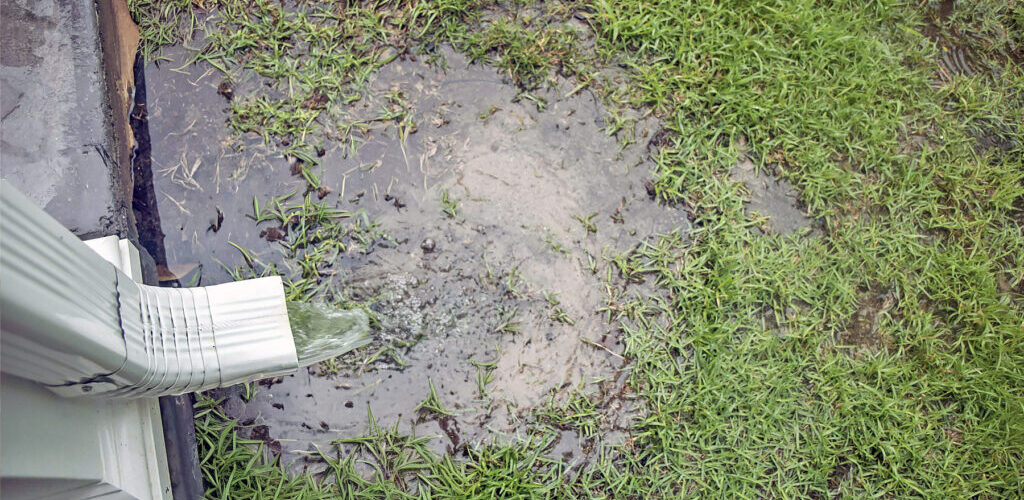
- Water exits strongly—but immediately turns back toward the house
- You see splash marks on the foundation or siding
- Mulch/soil gets trenched within minutes of rain
- The corner stays wet for days after storms
Most likely a GRADING / SOIL issue
- Large areas along one side stay wet, not just one corner
- Water pools even when downspouts discharge farther out
- The ground is flat, compacted, clay-heavy, or slopes toward the home
- You see water moving sideways along the foundation line
The 10-Minute “During Rain” Test
The most reliable diagnostic happens during moderate rain. You don’t need a ladder—just a quick walk.
Step 1: Check the gutters (2 minutes)
- Any corners dumping?
- Any seams dripping steadily?
- Any water running behind the gutter (hard to see—look for wet fascia edges)?
Step 2: Compare downspout discharge (3 minutes)
- Do all downspouts discharge with similar strength?
- Is one noticeably weaker or delayed?
- Does water back up near the outlet before it exits?
If you want a quick reference for what “good flow” looks like—and what usually causes a downspout to run weak—use downspouts and drainage in Southern Oregon as your baseline while you compare each discharge point.
Step 3: Watch what happens after water hits the ground (3 minutes)
- Does it flow away—or bounce/splash back?
- Does it carve channels in beds?
- Does it pool and sit near the foundation?
Step 4: Take photos (2 minutes)
- One photo of the gutter corner
- One photo of the downspout discharge
- One photo of any pooling/splash zone
Those three photos will usually tell you whether you’re looking at a system restriction, a bad landing zone, or grading/soil conditions.
The “One Corner” Rule
If one corner is always the problem—same puddle spot, same trenching, same wet foundation band—start with gutters/downspouts first. That pattern usually means water is being concentrated at a single exit point and landing poorly.
On the other hand, if an entire wall line is wet and muddy after storms, grading/soil becomes more likely.
And if that problem corner is also showing overflow stains or recurring drip marks, it may be a sign the system is aging or failing in that spot—not just a one-time clog. Here are the most common signs your gutters are failing so you can spot the difference early.
Common Scenarios (and What They Usually Mean)
“My gutters are clean but the corner stays wet.”
Usually discharge routing + compacted/flat soil at the corner. Corners are where multiple roof sections often dump, and they become collection zones fast.
“There’s trenching in my mulch beds after every storm.”
Usually high-volume discharge hitting loose soil. Even if gutters function perfectly, the landing zone is acting like a splash pit.
“We get musty smells in rainy weeks.”
Often recurring perimeter saturation. It can start as discharge too close to the house, then turn into broader soil moisture problems when the ground can’t dry out between storms.
“Water pools even when the downspout is extended.”
Often grading (flat or negative slope) or heavy compaction. At that point, you’re not just moving water—you’re fighting the ground.
What to Fix First (Order Matters)
If you’d rather follow a seasonal cadence instead of troubleshooting mid-storm, the fall gutter maintenance checklist lays out a simple two-pass routine that prevents most of these issues from starting in the first place.
To avoid wasting money, fix issues in this order:
1) Confirm the system isn’t restricted
- Clear outlets and elbows
- Confirm strong discharge at the exit point
2) Fix where water lands
- Move discharge away from corners when possible
- Use stable landing zones (not loose mulch beds)
- Add a splash block if erosion is the main issue
3) Only then evaluate grading/soil
- Look for negative slope toward the foundation
- Check for flat/compacted ground that won’t absorb water
- Watch whether water migrates sideways along the foundation line
If you’re seeing broader symptoms (staining, overflow marks, soft fascia, chronic wet zones), the bigger picture is covered in Water Damage From Gutters & Roof Runoff in Southern Oregon, which helps connect the “where it lands” problem to what it damages next.
When to Call a Pro
DIY is fine when you’re simply improving routing. But call a pro when you see any of the following:
- Repeat overflow in the same spot after cleanouts
- Standing water in gutters (pitch/sagging likely)
- Gutters pulling away, sagging, or leaking at seams
- Soft fascia/rotting wood or swollen trim
- Foundation pooling that doesn’t improve with better discharge
- Crawlspace moisture that worsens during rainy weeks
The goal is to stop the pattern—not just treat the symptoms.
FAQs
-
If one corner is always wet, start with downspout discharge and gutter flow. If an entire side stays wet, grading/soil is more likely.
-
Yes. Even with clean gutters, water can cause damage if it discharges too close to the home or into a flat/compacted landing zone.
-
Walk the house during moderate rain. Compare downspout discharge strength and watch whether water flows away, splashes back, or pools near the foundation.
-
Corners often receive concentrated runoff from multiple roof sections, and soil compacts faster there. That makes corners the highest-risk discharge zones.
-
Call a pro if overflow repeats after cleaning, gutters sag or pull away, fascia is soft/rotting, or foundation/crawlspace moisture persists despite better discharge routing.