Downspout Extensions: How Far Should Water Discharge From the House?
Key Takeaways
Most drainage problems aren’t “gutter problems”—they’re where the downspout dumps water.
The right distance is far enough to prevent pooling and splashback, and to keep water moving downhill.
Corners and low spots are the highest-risk areas for foundation moisture.
A “good” setup is the one that stays dry at the foundation during real rain, not just on sunny days.
If you’re seeing trenching, splash marks, or recurring puddles, your discharge routing needs an upgrade.
Forget the perfect number for a moment. The real goal is simple:
Water should not pool, splash, or soak the foundation perimeter.
A downspout extension is “long enough” when, during moderate rain:
-
You don’t see puddling near the house
-
You don’t see splash marks on the foundation or siding
-
You don’t see trenching/erosion in beds next to the home
-
The area dries out normally after storms
If any of those are happening, the discharge is too close—or it’s pointed at a bad landing zone.
If you’re trying to solve more than one symptom at once (pooling, splash marks, trenching), it helps to zoom out and think in terms of the whole system—from roof runoff to the landing zone. Our downspouts and drainage overview shows how to quickly verify the water path is actually moving away from the home.
A Helpful Starting Point (Most Homes)
As a general baseline, most homes do best when discharge is routed several feet away from the foundation—especially at corners.
But rather than getting locked into a single measurement, use this approach:
Start with “farther than the splash zone”
If your downspout ends where you can visibly see:
-
soil getting hammered
-
mulch being pushed aside
-
a muddy stripe on the foundation
…that’s too close.
Then adjust for slope
-
If the ground slopes away from the home: you can often discharge shorter.
-
If the ground is flat or slopes toward the home: you usually need more distance and better routing.
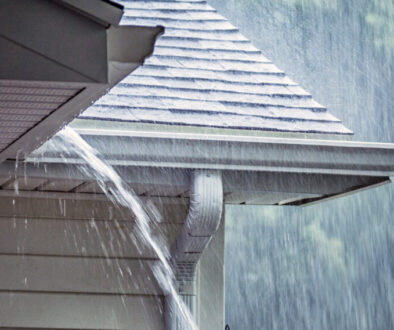
One thing that trips homeowners up: a setup can look “fine” on a dry day, but fail the minute real rain hits because the outlet area can’t move volume fast enough. If you’re seeing repeat overflow up top, this guide on early gutter failure signs helps you spot whether the issue is starting at the corner/outlet—not the ground.
Why Corners Are the Highest-Risk Discharge Points
A lot of downspouts terminate at corners because that’s where gutters naturally funnel water.
The problem: corners often become a “collection zone” for water because:
-
multiple roof sections dump there
-
soil compacts faster at the edge
-
runoff circles back along the foundation line
If you only improve one thing on your system, improve corner discharge.
Signs Your Downspout Discharge Is Too Close
If you see any of these, treat it as a real drainage issue—not cosmetic:
-
Pooling water within a few feet of the home
-
Foundation splash marks or a dark band on the concrete
-
Trenched mulch beds (little river channels)
-
Recurring wet spots that don’t dry after storms
-
Moss/algae growth in one perimeter zone from constant moisture
-
Crawlspace musty smell that worsens in rainy weeks
If you’re noticing more than one of these at once, it’s usually not just a “length” problem—it’s a repeat pattern. For a simple storm-ready cadence that prevents most of these symptoms from returning, use the fall gutter maintenance checklist as your baseline.
The “During Rain” Test (Fastest Diagnostic)
The best time to check downspout extensions is during moderate rain.
Walk the discharge areas and look for:
-
Does water shoot out and immediately turn back toward the house?
-
Does it hit the ground and splash onto the foundation?
-
Does the landing zone start eroding in minutes?
-
Does one downspout seem stronger/weaker than others?
That quick check will tell you whether your problem is:
-
a flow restriction (outlet/elbow/downspout clog)
-
or a routing problem (water exits fine but lands in the wrong place)
And if the “during rain” test points to a restriction (weak discharge, backup, corner dumping), don’t waste time chasing the landing zone until flow is fixed first. This quick breakdown of cleaning vs. repair helps you decide whether you’re dealing with debris—or a pitch/hanger/outlet issue that won’t improve with another cleanout.
Better Discharge Options (From Simple to “Set-and-Forget”)
1) Reposition the extension (fastest fix)
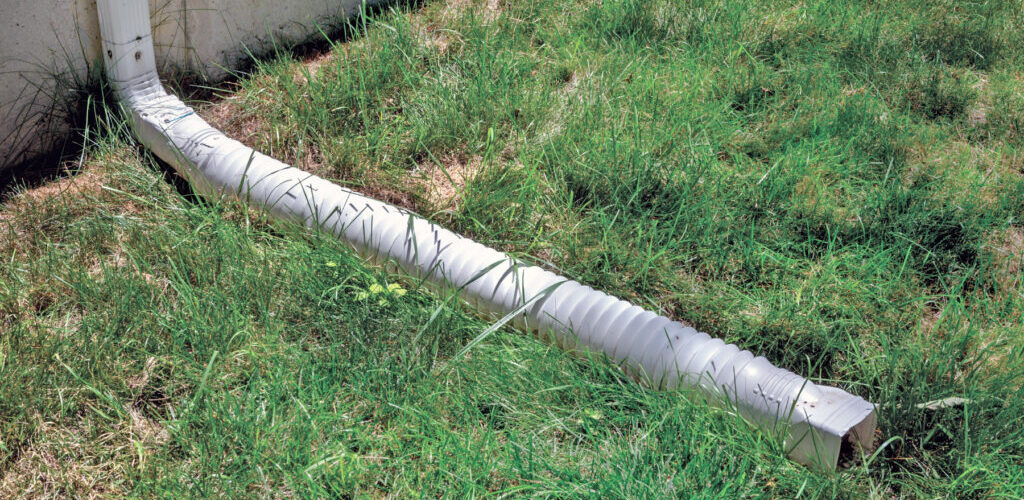
Sometimes the extension exists—it’s just pointed at the wrong spot. Rotate it so discharge lands:
-
on a slope away from the home
-
in a stable drainage path
-
away from beds that trench easily
2) Add a splash block (helps with erosion)
A splash block won’t solve pooling by itself, but it can:
-
reduce trenching
-
spread water out
-
protect soil and mulch
3) Route discharge away from corners
If you can, route water away from foundation corners—especially on the “problem side” of the home.
4) Extend to a safe drainage zone
A safe zone is:
-
downhill from the house
-
not aimed at the neighbor’s foundation
-
not dumping into a walkway that freezes/algae-slimes
If you’ve already redirected water to a “safe zone” and you’re still seeing wet perimeter symptoms, it’s often because the system is dumping too much volume too close, too often. This guide on what happens when gutters go unmaintained breaks down the common chain reaction—overflow, erosion, and moisture problems that compound over a season.
When It’s Not Just Extensions
If you extend discharge but still see water near the house, you may have:
-
grading issues (water naturally runs toward the home)
-
soil compaction that won’t absorb water
-
gutter/downspout flow restrictions that cause overflow before water even reaches discharge
-
multiple roof planes concentrating too much water at one point
That’s when you stop thinking “add more length” and start thinking “fix the water path.”
FAQs
-
Far enough that water doesn’t pool against the foundation, splash back onto the wall, or trench beds along the perimeter during real rain.
-
Often, yes. Gutters move water to a single exit point—extensions help ensure it lands in a safe place rather than soaking the foundation edge.
-
Recurring puddles near the foundation, splash marks on concrete or siding, and trenching/erosion where the downspout hits are the clearest signs.
-
Not always. Splash blocks help reduce erosion, but if the landing zone is too close to the home or flat, you still need better routing.
-
Because water is being dumped at that corner repeatedly, or the ground there is flat/compacted. Corners are the most common high-risk discharge zone.